
Introduction to MPSC Civil Judge Recruitment 2026
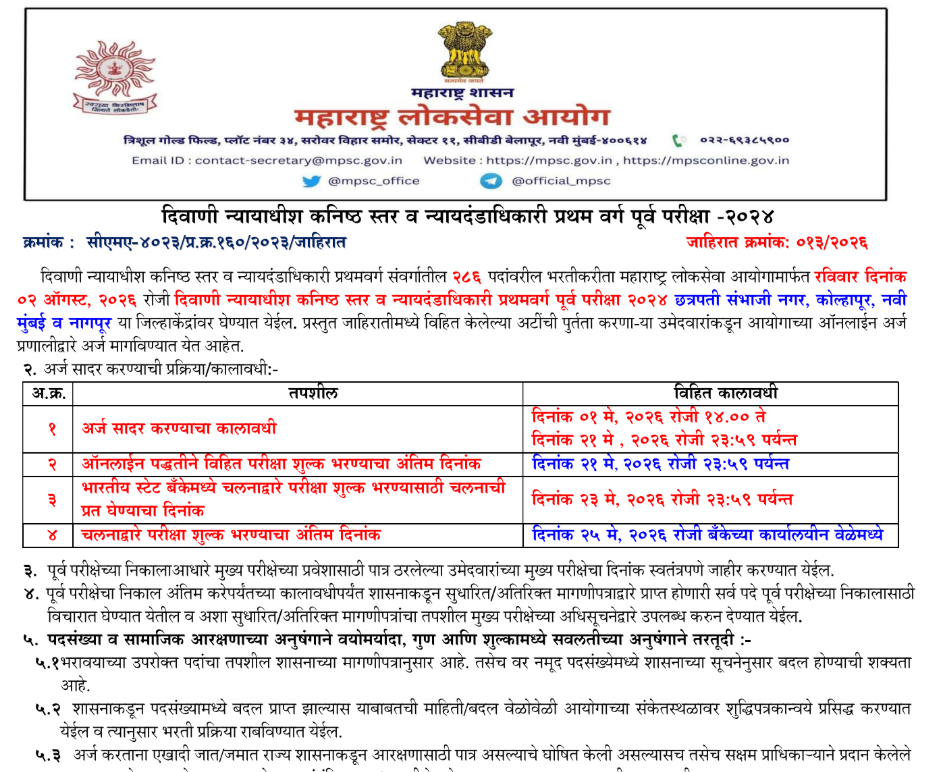
The Maharashtra Public Service Commission (MPSC) has officially announced the Civil Judge Junior Division and Judicial Magistrate First Class (CJJD & JMFC) Preliminary Examination 2026. This recruitment drive is one of the most significant in recent years, offering a substantial 286 vacancies to strengthen the judicial framework across Maharashtra. The post of a Civil Judge (Junior Division) and Judicial Magistrate First Class is a high-responsibility post in the state’s legal system and the foundation of the judiciary. The successful candidates would be expected to handle civil matters and criminal proceedings, meting out justice at the grass-root level fairly and expeditiously. The notice this year is of paramount importance since it includes the transition to India’s new criminal laws – Bhartiya Nyaya Sanhita (BNS), Bhartiya Nagrik Surksha Sanhita (BNSS), and Bhartiya Sakshya Adhiniyam (BSA) – in the syllabus of the exam. The recruitment seeks to attract new legal talent as well as seasoned practitioners, with different entry routes for fresh law graduates, practising advocates and experienced ministerial personnel inside the court system. This notification is a golden chance for the aspirants who aspire for a career full of public service, legal scholarship and constitutional obligation to join Maharashtra Judicial Service.
Age Limit
The age limit is calculatd as of April 30, 2026. For fresh law graduates: 21 to 25 years. For Practicing advocates/Public Prosecutors: 21 to 35 years For Ministerial staff: 21 to 45 years. Age Relaxation: Backward Classes/EWS/Orphans: 5 years relaxation PwBD: as per govt norms (typically 45 years)
Salary for Civil Judge Job
The selected candidates will be placed in the pay scale as per the 7th pay commission guidelines for judicial services. Pay scale: Rs 77,840-Rs 1,36,520 (plus applicable allowances like DA, HRA etc.)
Application fee MPSC Recruitment for civil judge
1. General Category: Rs 394 2. Backward classes/EWS/orphans: Rs 294 Payment mode: online
Educational Qualification
Candidates must possess one of the following eligibility criteria: 1. Fresh law graduates: Must have obtained a Degree in law with atleast 55% marks in the first attempt. 2. Practicing advocates: Must have a degree in law and at least 3 years of active practice as an advocate in High Court or Subordinate courts as of April 30, 2026. 3. Ministerial staff: Must have a degree in law and at least 3 years of service in the legal department or courts after obtaining the degree.
Selection Process
- 1Preliminary Exam: 100 marks, objective type, duration 2 hours
- 2Main Exam: two papers of 100 marks each, descriptive type, duration, 3 hours per paper.
- 3Interview: 50 marks
Syllabus for Civil Judge exam
Preliminary Exam: Covers the Code of Criminal Procedure, Civil Procedure Code, Evidence Act, Transfer of Property Act, Specific Relief Act, Maharashtra Rent Control Act, Limitation Act, Constitution of India, and Indian Penal Code. It also includes the newly implemented laws: Bhartiya Nyaya Sanhita, Bhartiya Sakshya Adhiniyam, and Bhartiya Nagrik Surksha Sanhita (BNSS). Main Exam: • Paper I: Civil Procedure Code, Transfer of Property Act, Specific Relief Act, Law of Contracts, Sale of Goods Act, and Partnership Act. • Paper II: Indian Penal Code, Evidence Act, Code of Criminal Procedure, SC/ST Act, Protection of Civil Rights Act, and an Essay on a current legal topic.
General Instructions
- Candidates must be proficient in the Marathi language (reading, writing and speaking)
- Applicants must ensure they meet the physical fitness standards required for judicial service.
- Incomplete application or those with incorrect information will be rejected without notice.
- The original documents must be presented at the time of interview.
How to Apply for MPSC Recruitment 2026 for Civil Judge
- 1Visit the official MPSC portal: mpsconline.gov.in.
- 2Complete the user registration if you are a new user.
- 3Fill in the profile creation (personal info, address, qualification, experience)
- 4Upload scanned copies of your photograph and signature.
- 5Select the civil judge junior division and JMFC Examination 2026 under the online application tab
- 6Pay the application fee via challan
- 7Submit the form and take a printout for future reference.
The Interesting facts about MPSC Civil Judge Recruitment
- The "Triple Law" Debut: 2026 is the first recruitment cycle where the Bhartiya Nyaya Sanhita (BNS), Bhartiya Nagrik Surksha Sanhita (BNSS), and Bhartiya Sakshya Adhiniyam (BSA) are officially part of the syllabus. You aren't just competing on law; you're competing on who can unlearn the IPC/CrPC/Evidence Act the fastest.
- The 286-Post Surge: This is one of the largest single-notification vacancy counts in Maharashtra’s judicial history. Typically, vacancies hover between 100–150. The jump to 286 suggests a massive drive to clear judicial backlogs in district courts.
- The "First Attempt" Rule for Freshers: Unlike many other state judiciary exams, MPSC maintains a strict "first attempt" rule for fresh graduates. If you didn’t pass each year of your LLB on the first try, you are ineligible to apply as a fresher, regardless of your final percentage.
- Negative Marking "Filter": The Preliminary exam uses a 1/4th (0.25) negative marking scheme. In a high-vacancy year like this, many candidates over-attempt questions, leading to a surprisingly low cut-off compared to low-vacancy years.
Expert analysis on Government law jobs
The 2026 MPSC vacancy is a “Golden Window” for applicants because of huge supply-demand gap in the lower judiciary of the state. Most of the websites are focusing on the high number of 286 postings but a little study shows that the competition will be disproportionately strong in the “Fresh Graduate” category as compared to the “Practicing Advocate” category. The 3-year compulsory practice regulation for advocates is a natural barrier, thus the ones who have retained their bar registration are statistically more likely to be chosen than a fresher who has a much narrower age band and a higher academic bar. From a syllabus point of view, the change to the New Criminal Laws (BNS, BNSS, BSA) levels the playing field. The new entrants do not have the “experience edge” that veteran candidates enjoyed after studying the IPC and CrPC for years. This change calls for a "Bare Act centric" approach as there is no settled case law for the new sections and the exam is bound to test the literal language and structural differences between the old and the new codes. It will be the combination of these laws with the local regulations particular to Maharashtra (such the Rent Control Act) that will determine the merit list. Finally, the need to know Marathi is the ultimate “silent filter.” The statistical patterns of the previous MPSC judicial exams suggest that a large percentage of otherwise eligible applicants could not qualify in the Mains due to the translation paper. In 2026, the MPSC could be more stringent on the minimum qualifying marks in the interview (40%) given the greater number of vacancies for quality assurance. Hence, the candidates should not think of it as just a law paper. It is a linguistic and procedural marathon and consistency in Marathi translation is as important as legal understanding.
Pro-tip for Gyapak Readers
The 286 vacancies for 2026 represent more than just a job opening; they represent a significant modernization of the Maharashtra judiciary. Because this exam introduces the New Criminal Laws (BNS, BNSS, BSA), the traditional hierarchy of "senior aspirants" is reset. Focus your preparation on the literal interpretation of the new sections in the Bhartiya Nyaya Sanhita, as the commission is likely to test basic conceptual clarity before moving into complex applications in future years.
Perks & benefits of Civil Judges
Judicial officers in Maharashtra enjoy significant benefits that ensure their independence and a comfortable lifestyle: Revised Pay Scale: Under the latest judicial pay commission guidelines, a Junior Civil Judge starts with a basic pay of approximately ₹77,840, which can go up to ₹1,36,520 plus significant allowances. Housing & Accommodation: Most officers are provided with designated government quarters (Judicial Quarters). In cases where quarters are unavailable, a high House Rent Allowance (HRA) is provided. Official Conveyance: Judges are provided with a government vehicle or a substantial conveyance allowance for official travel and commuting. Staff Support: You are entitled to a dedicated support team, including a steno/typist, a peon (orderly), and court clerks to assist in judicial and administrative work. Medical & Leave Travel: Comprehensive medical reimbursement for the officer and their family, along with Leave Travel Concession (LTC) for vacations. Retirement Security: A dignified post-retirement life with a substantial pension and gratuity benefits.
Career progression in government law jobs
The career of a Civil Judge is structured with clear milestones based on both seniority and merit: 1. Civil Judge Junior Division (CJJD) & JMFC: Your entry-level posting. 2. Civil Judge Senior Division (CJSD): Generally eligible for promotion after 5 years of service. This involves handling more complex civil suits and higher financial valuations. 3. District & Sessions Judge: The next major leap. You can reach this through Regular Promotion (65% quota) based on seniority-cum-merit or through the Accelerated Promotion (10% quota) by clearing a Limited Competitive Examination earlier in your career. 4. High Court Judge: Outstanding District Judges with an impeccable track record and high-quality judgments may be elevated to the High Court by the Supreme Court Collegium.
The future of the Judiciary
The judicial landscape is undergoing a massive "Digital Transformation." As a judge in the 2026 batch, your future will be defined by: AI-Integrated Courts: You will likely use Artificial Intelligence tools for legal research, automated case management, and even draft-screening of routine applications. E-Courts & Paperless Judiciary: The transition to "Phase III" of the e-Courts project means you will be presiding over more virtual hearings and managing digital evidence. Implementation of New Laws: You will be among the first generation of judges to establish the jurisprudence for BNS, BNSS, and BSA, giving you a unique opportunity to shape how India's new criminal laws are interpreted in the coming decades.
Frequently Asked Questions
Comments
Login to join the discussion
Log inNo comments yet